Our junior members were also busy all day, with large numbers of the public enthralled by their display of colonial toys.
Welcome to the website for Capt. Richard Gardiner's Company of the New Jersey Provincial Frontier Guard, 1756.
The New Jersey Frontier Guard is a non-profit educational corps whose mission is the accurate portrayal of life in the Royal Province of New Jersey during the period of the French and Indian War (1756 - 1763)
Tuesday, August 25, 2015
Roasted Ears of Corn
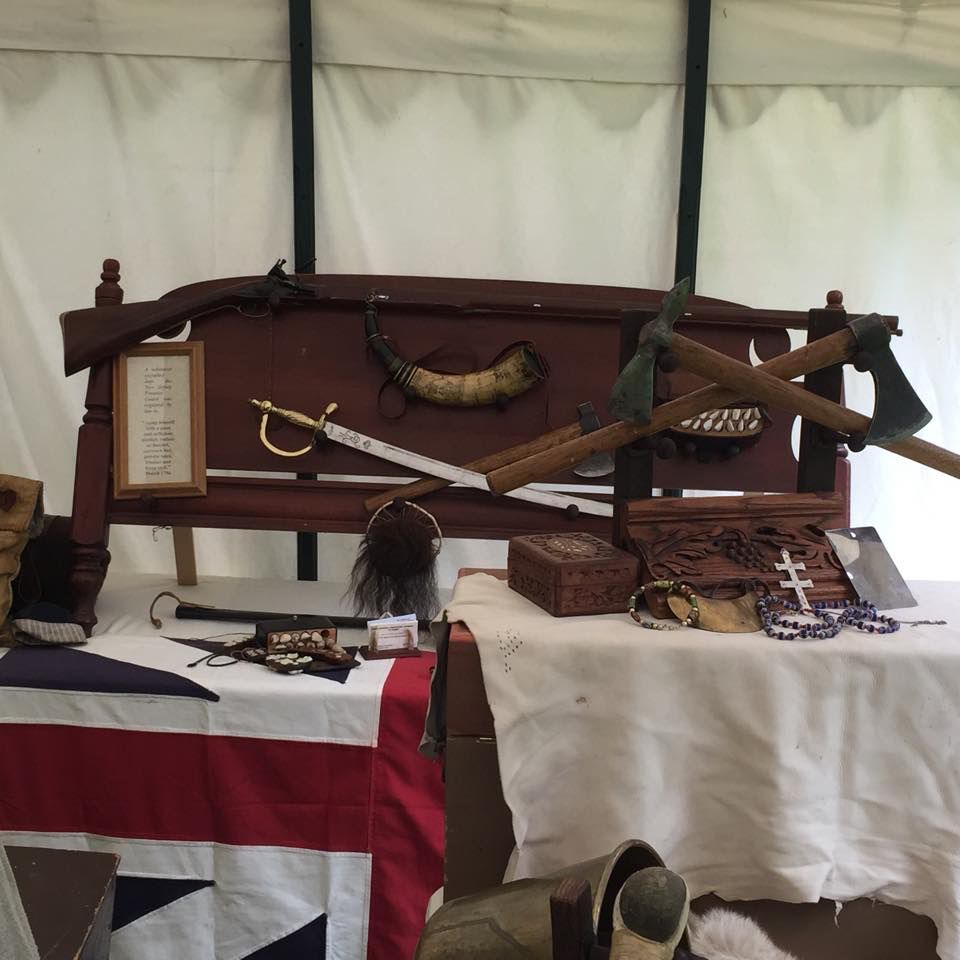
This past weekend, the Frontier Guard took part in the Roasting Ears of Corn Festival at the Museum of Indian Culture in Allentown, PA. There was a large and enthusiastic crowd, and people seemed to enjoy our display.
Monday, August 24, 2015
Whispering Pines 2015
This post is not connected directly to the Frontier Guard, but just as last year, my family and I travelled to the Endless Mountains to the Whispering Pines Rendezvous near Wellsboro. We set up the huge Marquee tent I got two years ago when Eddie decided he no longer wanted to spend four hours setting up and taking down his camp (Enjoy North Carolina, Eddie!).
It was hot - far warmer than in past years, and much hotter than it needed to be, but of course there's nothing anyone could do about that. The young ones met and played with friends; I shot a bit, and shot the breeze more; we sold a few trade goods, including a voyageur cap, a wampum horn strap, and a powder horn I made.
.
It was hot - far warmer than in past years, and much hotter than it needed to be, but of course there's nothing anyone could do about that. The young ones met and played with friends; I shot a bit, and shot the breeze more; we sold a few trade goods, including a voyageur cap, a wampum horn strap, and a powder horn I made.
One of my favorite activities of the weekend is singing in the evening, and there was plenty of that. My friends John and Rose were playing and singing great music, and Saturday night we had several guitars playing, as well as violin, mandolin, and harmonica. I sang Irish songs, traditional tunes, and even a bit of opera, and people were kind enough to tolerate me. While I was probably a bit out of line to take a photo, I wanted to be able to preserve the memory and share it.
Saturday, August 8, 2015
Dixon's Gunmakers' Fair 2015
One of the main events each summer for fans of muzzleloading and of history is the Gunmakers' Fair at Dixon's Muzzleloading shop in Kempton, PA. Held the last full weekend in July, the fair attracts makers of fine guns, clothing, knives and tomahawks, horns, bags, accessories, and supplies.
My friends Chuck and Lori Beasley, of American Heritage Clothing, were there with a great selection of uniforms and clothing, as well as some firearms to sell.
As usual, prominent gun builders like Allen Martin and Kenneth Gahagan were in attendance. Allen is always a treat to talk with. He offered to buy my rifle back at the price I paid for it ten years ago, saying he could sell it for twice the price today - I declined. His sons were with him this year, the next generation of gun builders, I hope.
My friends Chuck and Lori Beasley, of American Heritage Clothing, were there with a great selection of uniforms and clothing, as well as some firearms to sell.
Eric Von Aschweg had some interesting news: he's going to be working at Colonial Williamsburg in the summers in the Gunmakers' Shop. He's a nice guy and a skilled maker; he should be a great addition there.
Several former members of the Frontier Guard- Ted, Al, and Bill - were in attendance. They decided to focus more on civilian impressions, the seventeenth century in particular.
They've formed a group called the Colonial Living History Alliance. Check them out.
As usual, the displays of arms and accoutrements were impressive.
Saturday, August 1, 2015
A Small Knife
I picked up a small paring knife this spring at a garage sale - they were literally giving away knives, and this was among my two or three pickups. I drilled out the rivets, used a small antler I had found a few years back in the grass, and re-handled the blade to give it a more eighteenth-century appearance.
To give an idea of size, the blade is just under four inches, and the background is a sheet of 8 1/2" x 11" paper.
I like the patina on the blade, so I left it as it is. Now the next step is a sheath. Let me know what you think.
Here it is with the sheath - a traditional center-seam.
(Images coming as I reconstruct from Photobucket changing terms of service and hurting users)
Sunday, July 19, 2015
A New Game Bag
Over last winter, I picked up some jute fabric in a herringbone pattern. The fabric is a bit coarse, but strong, and looked like it would make a nice fabric for a haversack or game bag. Jute fabric has been around for a long time; the British East India Company imported it from India in the seventeenth through nineteenth centuries, so a game bag made from jute fabric is a historical possibility, albeit based on guesswork and supposition, rather than on any historical example.
Easton Heritage Day 2015
One of the Guard's bigger events each year is Easton's Heritage Day festival, which commemorates the day the Declaration of Independence was read in the Town. For the NJ Frontier Guard, the town has a more direct significance - it was here in 1758 that the Treaty of Easton was signed, formally ending hostilities between the Lenape and His Majesty's subjects. Although the NJ frontier along the Delaware remained dangerous until at least 1761, the treaty did bring a large measure of security to the area. For the Lenape the treaty meant that the tribe was formally able to shrug off the dominance of the Iroquois League and the appellation of "women" that came with it. The Treaty of Easton marked a shift in the tide of the French and Indian War, as many tribes that has previously allied themselves with the French came to terms with the English and colonial governments, thanks to the diplomacy of George Crogan, Sir William Johnson, the Delaware sachem Teedyscung, and other diplomats. For anyone who wants to see the original document of the Treaty of Easton, it is nicely displayed in the Sigal Museum in downtown Easton, and I make a point of seeing it each time I participate in Heritage Day.
While I was in Europe in the first part of July with family, and thus missed this year's festival, the event was, according to Capt. Pitchell, even bigger and better than in previous years. The photos of the event certainly bear out his assessment.
As usual, the event organizers provided a nice lunch for participants.
While temperatures hovered near 90*F, the weather was sunny, and there were large crowds in attendance. Another successful event!
Friday, July 17, 2015
Blairstown on July 4th
Although the Frontier Guard commemorates an era twenty years before American Independence, when all colonists were loyal to His Majesty George II, nonetheless members of the Guard took part in Blairstown's Independence Day celebration:
Monday, June 22, 2015
Two Events Coming up in July
The Frontier Guard has two events coming up in July.
Come see us on Independence Day in Blairstown, and on July 12th at Easton Heritage Day. You'll be glad you did.
Thursday, June 18, 2015
Traditional German Rouladen
Since my last post was on cooking, I thought I'd stick with that theme for one more post and cover the other end of the spectrum from ship's biscuit.
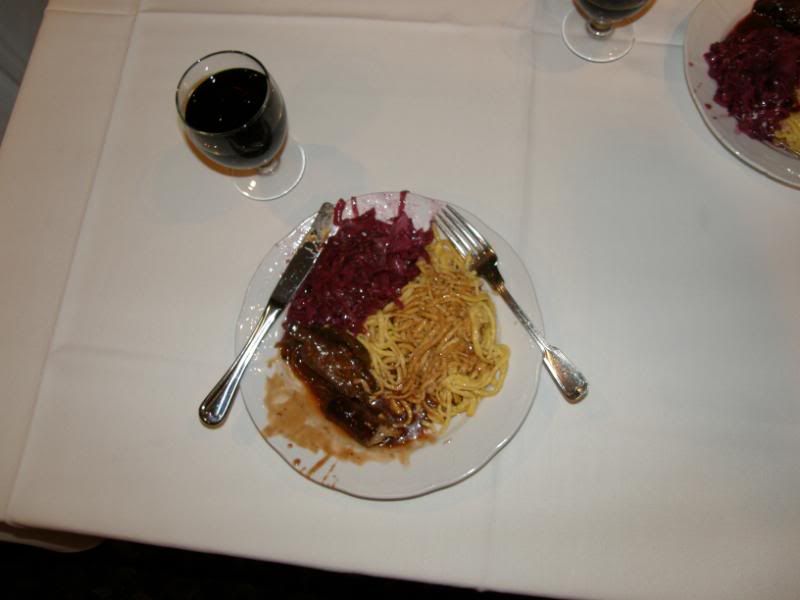
Tonight I cooked traditional beef rouladen for dinner:
Variations on rouladen go back to the 16th century, according to Colonial Williamsburg; in Britain stuffed rolled beef was known as "beef olives" from their shape. German rouladen goes back at least to the early 18th century, and settlers from Bavaria may have brought it with them to the colonies. That is speculation, of course, but when the result is this good, few will argue too hard.
My apologies for the poor photo; the meat looks too dark, but at least it gives you an idea of the braised beef with a rich red wine sauce.
Take thin slices of beef, top or bottom round about 1/4" thick, tenderize them with a mallet, and paint them with Dijon mustard. Place a strip of bacon on each, add a sliced gherkin or mild dill pickle and a wedge of onion, roll up, and secure the roll with a skewer or toothpick. Brown in a deep skillet with a small bit of fat; goose fat is best. Set aside.
Add half a bottle of strong red wine to an equal amount of beef stock in the skillet. Put in a chopped carrot, fresh thyme, 4 cloves of garlic, 5-6 bay leaves, a pinch of ginger, and a pinch of salt. Bring the liquid to a boil, add the beef rolls back in, and simmer over a lower heat for 45 minutes to an hour, adding more wine as necessary (just save a glass for the cook).
After the meat is tender and the liquid is reduced, take out the rouladen. Add a tablespoon of tomato paste or a bit more, thicken as necessary with a bit of flour or corn starch, and strain the sauce.
Plate the rouladen and pour sauce over them.
Serve with SpƤtzle and perhaps cucumber salad, or with asparagus or string beans.
Here's a photo from another occasion, this time made with a side of red cabbage:
Tonight I cooked traditional beef rouladen for dinner:
Variations on rouladen go back to the 16th century, according to Colonial Williamsburg; in Britain stuffed rolled beef was known as "beef olives" from their shape. German rouladen goes back at least to the early 18th century, and settlers from Bavaria may have brought it with them to the colonies. That is speculation, of course, but when the result is this good, few will argue too hard.
Take thin slices of beef, top or bottom round about 1/4" thick, tenderize them with a mallet, and paint them with Dijon mustard. Place a strip of bacon on each, add a sliced gherkin or mild dill pickle and a wedge of onion, roll up, and secure the roll with a skewer or toothpick. Brown in a deep skillet with a small bit of fat; goose fat is best. Set aside.
Add half a bottle of strong red wine to an equal amount of beef stock in the skillet. Put in a chopped carrot, fresh thyme, 4 cloves of garlic, 5-6 bay leaves, a pinch of ginger, and a pinch of salt. Bring the liquid to a boil, add the beef rolls back in, and simmer over a lower heat for 45 minutes to an hour, adding more wine as necessary (just save a glass for the cook).
After the meat is tender and the liquid is reduced, take out the rouladen. Add a tablespoon of tomato paste or a bit more, thicken as necessary with a bit of flour or corn starch, and strain the sauce.
Plate the rouladen and pour sauce over them.
Serve with SpƤtzle and perhaps cucumber salad, or with asparagus or string beans.
Here's a photo from another occasion, this time made with a side of red cabbage:
Ship's Biscuit
In preparation for the demonstration for the Cub Scouts, I baked up a batch of Ship's Biscuit. Later generations came to know these as hardtack, but in the 18th century, as far as I know, they were simply called ship's biscuit, or simply biscuit.
The recipe is very simple: flour, a pinch of salt, and enough water to make a pasty dough. Form into cakes about 3/4" thick and about 2" by 3" in size. Place on a lightly-greased pan or cookie sheet. Bake at 350* for at least 30 minutes, turn, and bake for at least another 30 minutes. Taking them out of the oven, leave them out to cool and "cure" for a day or two. They will become nearly as hard as rocks (and only slightly more appetizing than rocks when eaten dry and by themselves), but they will keep for a long time - years, in fact.
If soaked in milk or gravy, or crumbled up to thicken a stew or soup, they become much more palatable.
As anyone who grew up reading C.S. Forester's "Hornblower" series knows, the British Navy shipped these biscuits all over the world on naval vessels, packed in barrels. Tapping the biscuits on the edge of the table supposedly drove out the weevils that infested them, or one could eat the bugs for the added protein, of course, but I suspect most would have to be pretty hungry for that.
.
Subscribe to:
Posts (Atom)