Saturday, August 1, 2015

A Small Knife

I picked up a small paring knife this spring at a garage sale - they were literally giving away knives, and this was among my two or three pickups.  I drilled out the rivets, used a small antler I had found a few years back in the grass, and re-handled the blade to give it a more eighteenth-century appearance.


To give an idea of size, the blade is just under four inches, and the background is a sheet of 8 1/2" x 11" paper.

I like the patina on the blade, so I left it as it is.  Now the next step is a sheath.  Let me know what you think.

Here it is with the sheath - a traditional center-seam.


(Images coming as I reconstruct from Photobucket changing terms of service and hurting users)


Sunday, July 19, 2015

A New Game Bag

Over last winter, I picked up some jute fabric in a herringbone pattern.  The fabric is a bit coarse, but strong, and looked like it would make a nice fabric for a haversack or game bag.  Jute fabric has been around for a long time; the British East India Company imported it from India in the seventeenth through nineteenth centuries, so a game bag made from jute fabric is a historical possibility, albeit based on guesswork and supposition, rather than on any historical example.


Easton Heritage Day 2015

One of the Guard's bigger events each year is Easton's Heritage Day festival, which commemorates the day the Declaration of Independence was read in the Town.  For the NJ Frontier Guard, the town has a more direct significance - it was here in 1758 that the Treaty of Easton was signed, formally ending hostilities between the Lenape and His Majesty's subjects.  Although the NJ frontier along the Delaware remained dangerous until at least 1761, the treaty did bring a large measure of security to the area.  For the Lenape the treaty meant that the tribe was formally able to shrug off the dominance of the Iroquois League and the appellation of "women" that came with it.  The Treaty of Easton marked a shift in the tide of the French and Indian War, as many tribes that has previously allied themselves with the French came to terms with the English and colonial governments, thanks to the diplomacy of George Crogan, Sir William Johnson, the Delaware sachem Teedyscung, and other diplomats.  For anyone who wants to see the original document of the Treaty of Easton, it is nicely displayed in the Sigal Museum in downtown Easton, and I make a point of seeing it each time I participate in Heritage Day.

While I was in Europe in the first part of July with family, and thus missed this year's festival, the event was, according to Capt. Pitchell, even bigger and better than in previous years.  The photos of the event certainly bear out his assessment.


As usual, the event organizers provided a nice lunch for participants.


While temperatures hovered near 90*F, the weather was sunny, and there were large crowds in attendance.  Another successful event!


Friday, July 17, 2015

Blairstown on July 4th

Although the Frontier Guard commemorates an era twenty years before American Independence, when all colonists were loyal to His Majesty George II, nonetheless members of the Guard took part in Blairstown's Independence Day celebration:


Despite the rain, the crowds, according to Capt. Pitchell, were large and enthusiastic.


Monday, June 22, 2015

Two Events Coming up in July

The Frontier Guard has two events coming up in July.  

Come see us on Independence Day in Blairstown, and on July 12th at Easton Heritage Day.  You'll be glad you did.

Thursday, June 18, 2015

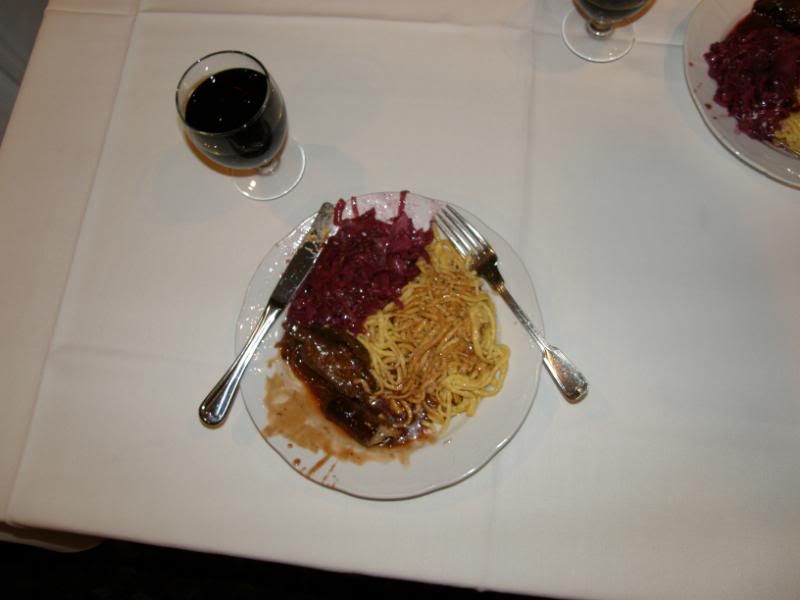
Traditional German Rouladen

Since my last post was on cooking, I thought I'd stick with that theme for one more post and cover the other end of the spectrum from ship's biscuit.

Tonight I cooked traditional beef rouladen for dinner:


Variations on rouladen go back to the 16th century, according to Colonial Williamsburg; in Britain stuffed rolled beef was known as "beef olives" from their shape. German rouladen goes back at least to the early 18th century, and settlers from Bavaria may have brought it with them to the colonies.  That is speculation, of course, but when the result is this good, few will argue too hard.


My apologies for the poor photo; the meat looks too dark, but at least it gives you an idea of the braised beef with a rich red wine sauce.

Take thin slices of beef, top or bottom round about 1/4" thick, tenderize them with a mallet, and paint them with Dijon mustard. Place a strip of bacon on each, add a sliced gherkin or mild dill pickle and a wedge of onion, roll up, and secure the roll with a skewer or toothpick. Brown in a deep skillet with a small bit of fat; goose fat is best. Set aside. 


Add half a bottle of strong red wine to an equal amount of beef stock in the skillet. Put in a chopped carrot, fresh thyme, 4 cloves of garlic, 5-6 bay leaves, a pinch of ginger, and a pinch of salt. Bring the liquid to a boil, add the beef rolls back in, and simmer over a lower heat for 45 minutes to an hour, adding more wine as necessary (just save a glass for the cook).

After the meat is tender and the liquid is reduced, take out the rouladen. Add a tablespoon of tomato paste or a bit more, thicken as necessary with a bit of flour or corn starch, and strain the sauce.

Plate the rouladen and pour sauce over them. 

Serve with SpƤtzle and perhaps cucumber salad, or with asparagus or string beans.

Here's a photo from another occasion, this time made with a side of red cabbage:


Ship's Biscuit

In preparation for the demonstration for the Cub Scouts, I baked up a batch of Ship's Biscuit.  Later generations came to know these as hardtack, but in the 18th century, as far as I know, they were simply called ship's biscuit, or simply biscuit.

The recipe is very simple: flour, a pinch of salt, and enough water to make a pasty dough.  Form into cakes about 3/4" thick and about 2" by 3" in size. Place on a lightly-greased pan or cookie sheet. Bake at 350* for at least 30 minutes, turn, and bake for at least another 30 minutes.  Taking them out of the oven, leave them out to cool and "cure" for a day or two.  They will become nearly as hard as rocks (and only slightly more appetizing than rocks when eaten dry and by themselves), but they will keep for a long time - years, in fact.


If soaked in milk or gravy, or crumbled up to thicken a stew or soup, they become much more palatable.

As anyone who grew up reading C.S. Forester's "Hornblower" series knows, the British Navy shipped these biscuits all over the world on naval vessels, packed in barrels.  Tapping the biscuits on the edge of the table supposedly drove out the weevils that infested them, or one could eat the bugs for the added protein, of course, but I suspect most would have to be pretty hungry for that.

.

Monday, June 15, 2015

Demonstration for Cub Scouts

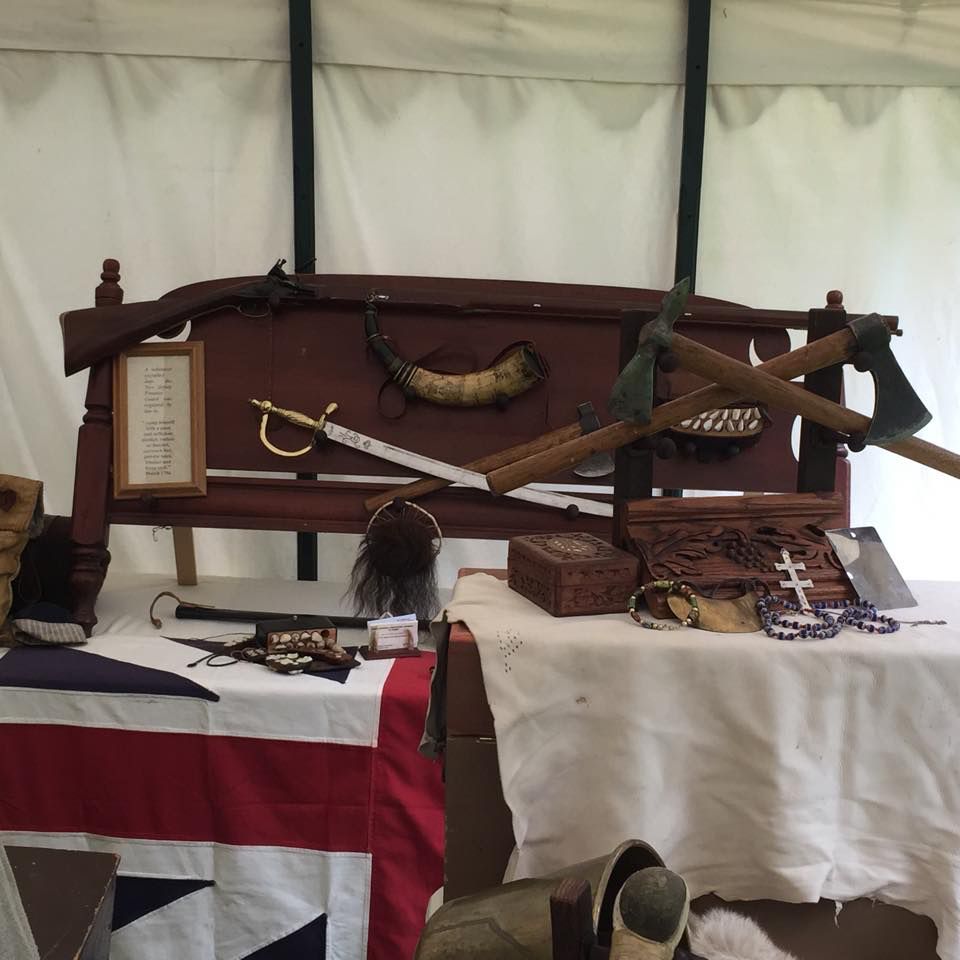
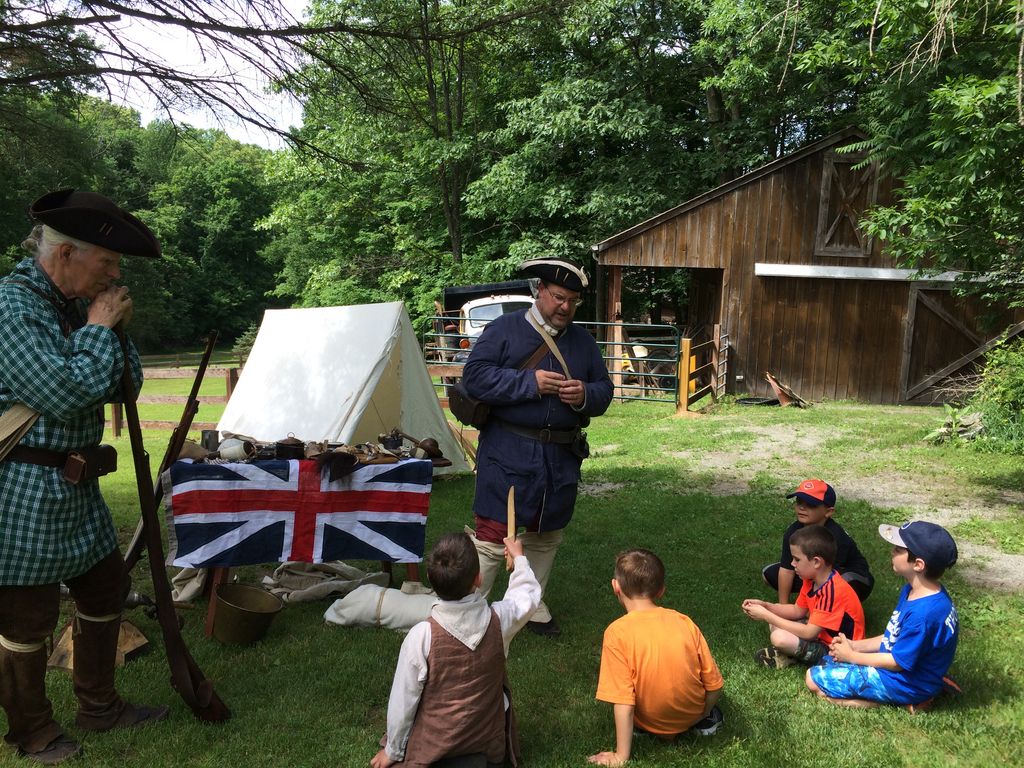
On Saturday Capt. Pitchell and I spoke to my son's Cub Scout den.  We showed the boys and their parents the gear and weapons of the Frontier Guard...


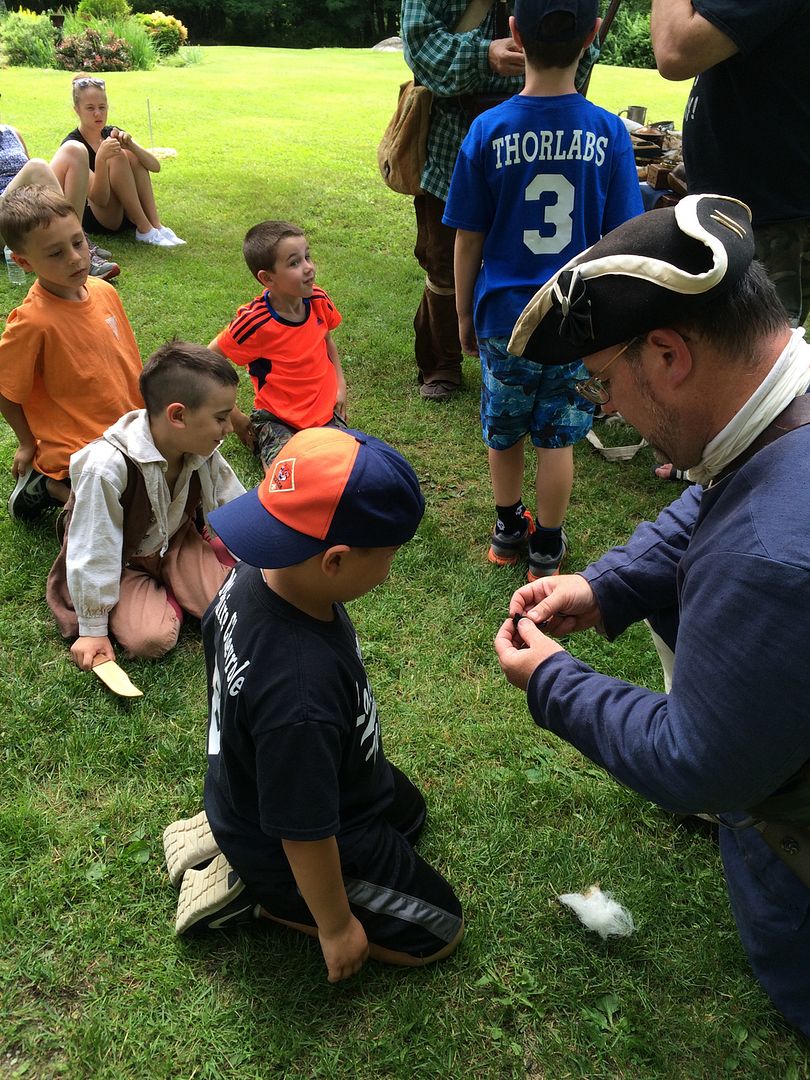
We demonstrated fire starting, and let the boys and parents try for themselves.


We fired off our firelocks...


...and also the small swivel.


The boys played some of the colonial games, and we finished up by letting them try their hand at throwing tomahawks.  Several of the boys managed to stick a hawk on one try, and one young man managed to stick it twice in a row (I think he has a future in hawk-throwing).


I'll finish up by tooting our own horn a bit - copying some of the feedback we received from the event...

"A great big thank you to you!   We have been discussing how much fun we had tonight.  What a fantastic presentation you gave!"

"That was a lot of fun and really entertaining.   It was just enough teaching,   With the right  amount of hands on.  The adults had as good as time as the boys.  We will be asking your service again for sure."

"It was a wonderful afternoon for both kids and adults. We look forward to Quiet Valley in the fall.  Thank you again!"


Sunday, May 10, 2015

The NJ State History Fair at Monmouth Battlefield State Park

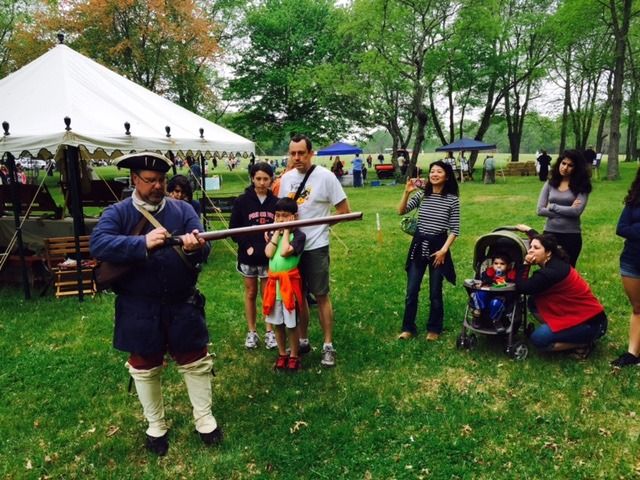
On Saturday the Frontier Guard set up an exhibit at the Spirit of the Jerseys State History Fair.  While we were slightly confused that event organizers decided not to place us in the Military Timeline, it actually worked out very well.  Our tent was located in the 18th Century area, right as the public entered, so we were busy all day.  Despite the weather report, the day started off rainy and chilly.  Luckily, it did brighten up mid-afternoon and get a bit warmer.


More to come!